

Valencian Community
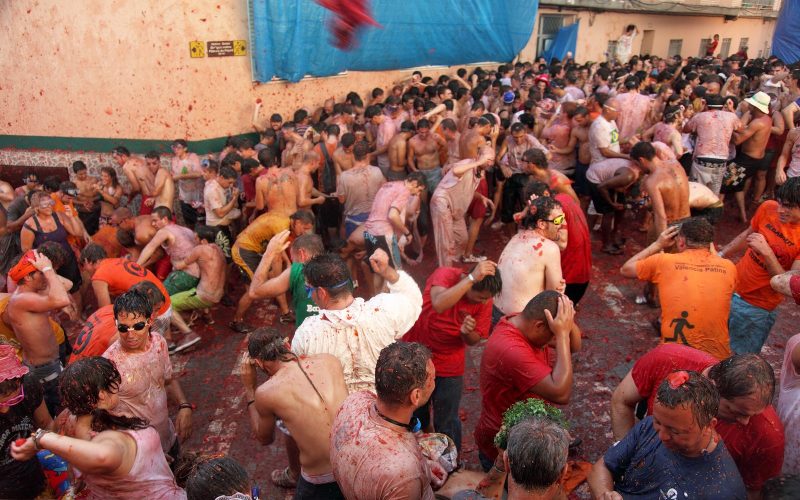
The Valencian Community, on Spain’s Mediterranean coast: the home of paella, and of La Tomatina in Buñol, held on 26 August in 2026.
At a glance
- The home of paella valenciana, the rice dish of the Valencia plain
- La Tomatina in Buñol, about 40 km west of Valencia, in late August
- Commuter trains (Cercanías line C3) link Valencia with Buñol
- A coast of rice fields, orange groves and the Albufera lagoon south of Valencia
- 1food festival
Food festivals in Valencian Community
 flydime, CC BY-SA
Cities and towns in Valencian Community
 Enrique Íñiguez Rodríguez (Qoan), CC BY-SA
Map of Valencian Community
What to taste in Valencian Community
Paella valenciana
The original paella, made with rice, chicken, rabbit and green beans. It is the plate served in the official La Tomatina packs.
Horchata with fartons
A cold drink made from tiger nuts, with long, sugar-glazed buns for dipping.
Valencia oranges
The citrus of the coastal plain, sold fresh and squeezed into juice across the region.
Arròs a banda
Rice cooked in fish stock, a dish of the coast.
The Valencian Community stretches along Spain’s Mediterranean coast, from the provinces of Castellón in the north to Alicante in the south, with the city of Valencia at its centre. It is rice country: the plain and the Albufera lagoon south of Valencia grow the short-grain rice of paella, and orange groves line the coast.
Rice, oranges and a tomato fight
- Paella valenciana: the region’s best-known dish, made in a wide, shallow pan.
- Horchata: a cold tiger nut drink, served with fartons, long glazed buns.
- La Tomatina: the tomato battle of Buñol, inland of Valencia, held on the last Wednesday of August by tradition, according to its official site. In 2026 it took place on 26 August.
The food is built on the produce of the huerta, the irrigated market gardens around Valencia, and on rice from the Albufera. At La Tomatina, the official packs serve a plate of paella valenciana after the battle.
Spanish and Valencian are both official languages here, so you will see València as well as Valencia, and Bunyol as well as Buñol.
Albufera rice and the water of the huerta
Rice grew in the old Kingdom of Valencia before Jaime I conquered it in 1238: the Llibre dels Repartiments, which shared out the conquered land, already describes rice fields, according to the specification of the Arroz de Valencia designation.
- The PDO: Arroz de Valencia, grown in natural wetlands of the provinces of Alicante, Castellón and Valencia, from varieties such as Senia, Bomba and Albufera.
- The Albufera: a natural park of 21,120 hectares, 65 percent of it rice fields. The specification calls rice the only crop possible there.
- In 1753 a regulation of King Fernando VI drew the boundaries of the rice-growing areas.
- The tiger nut: the base of horchata has its own designation of origin, Chufa de Valencia, and is the most distinctive crop of the fields of Alboraya.
Every Thursday at noon, at the Apostles’ Door of Valencia Cathedral, eight farmers representing the irrigation canals of the huerta sit as the Tribunal de las Aguas, the Water Court, in Valencian. The city’s tourist office calls it the oldest legal institution in Europe, and it has been UNESCO intangible cultural heritage since 2009.
Valencia as the hub of the Valencian Community
- Gateway: an international airport, high-speed trains to Madrid and the Cercanías commuter network, run by Renfe.
- Buñol: line C3 reaches it, about 40 km west of the city, according to the Tomatina’s organisers.
- Heat: summers are hot, especially inland, which matters for an outdoor event in late August.
Before you go
- Gateway: Valencia, the regional capital, has an international airport and high-speed trains to Madrid.
- Summer heat: July and August are hot inland. Plan shade and water for outdoor events.
- La Tomatina: an official ticket is required for the battle in Buñol, and capacity is limited.
- Getting to Buñol: Cercanías line C3 from Valencia. On Tomatina day, the trains fill quickly.
- Languages: Spanish and Valencian are both official, and place names often appear in both forms.
Frequently asked questions
Where is La Tomatina?
In Buñol, a town about 40 km west of Valencia, according to the official site.
Is paella from Valencia?
Yes. Paella valenciana comes from the rice-growing plain around the city of Valencia.
How do you get from Valencia to Buñol?
By the Renfe Cercanías commuter line C3, which links Valencia with Buñol.
When is La Tomatina 2027?
Not announced yet on 14 October 2026. The 2026 battle was held on 26 August.